Charting how specialized player guides adapt Texas Hold'em tactics to shifting casino game formats in live tournament circuits
Finley Foster · Nov 18, 2026

Charting how specialized player guides adapt Texas Hold'em tactics to shifting casino game formats in live tournament circuits
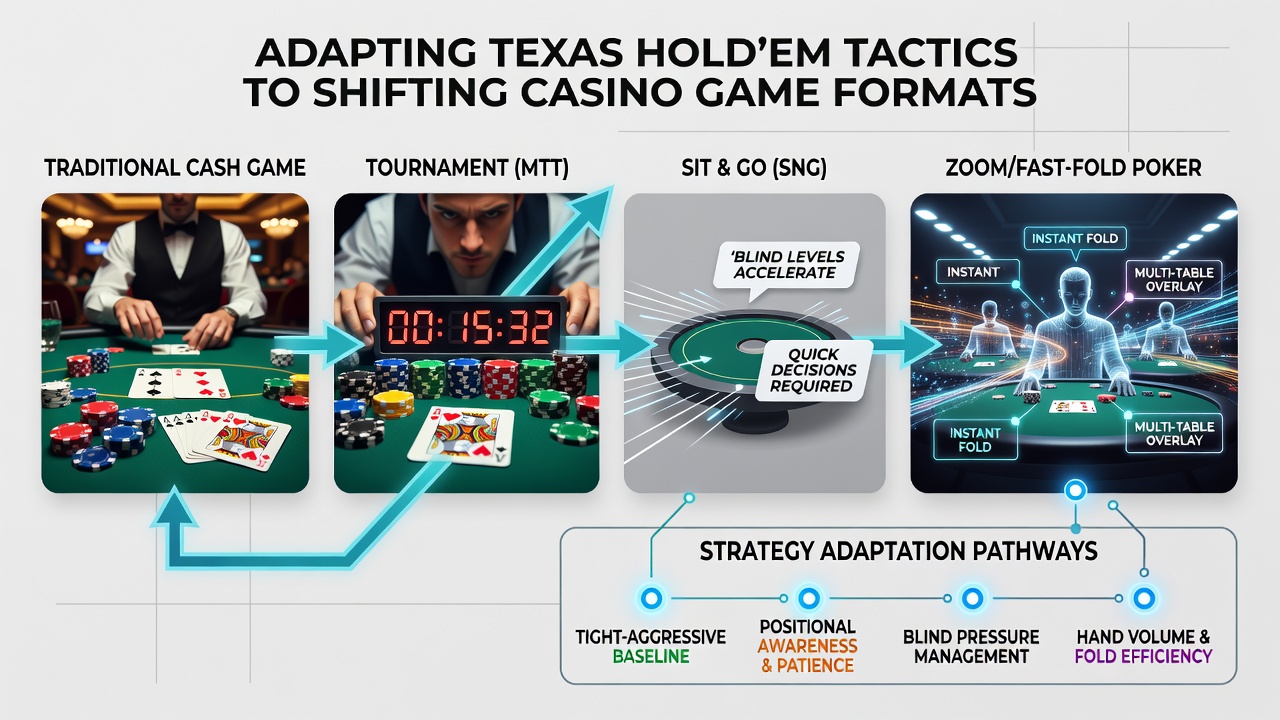
Specialized player guides track adjustments that competitors apply when live tournament circuits alter their structures, and these resources compile data on how stack depths, blind levels, and payout schedules influence decision points in Texas Hold'em. Observers note that circuits frequently rotate between deep-stack freezeouts and faster formats that incorporate antes plus re-entry options, which forces guides to revise opening ranges and post-flop frequencies accordingly.
Format Variations Across Live Circuits
Live circuits present formats that range from standard single-table satellites to multi-day main events with escalating antes, and guides catalog how these changes affect pre-flop raise sizes along with continuation bet frequencies. Data from the Nevada Gaming Control Board shows that average tournament durations have shortened in several venues since 2024, prompting updates to shove-fold charts that account for rising blind pressure earlier in the day.
Rebuy periods and bounty mechanics further modify stack distributions, so guides incorporate separate modules that detail when players should widen calling ranges against shorter effective stacks. Those who study circuit schedules observe that November 2026 lineups include several events shifting from 30-minute levels to 20-minute levels mid-series, which alters the value of speculative hands and reduces implied odds for drawing combinations.
Adjustments Documented in Player Resources
Guides break down positional awareness under varying ante structures, and they present hand histories that illustrate how late-position aggression increases when antes reach 12.5 percent of the big blind. Researchers at the University of Nevada, Las Vegas have analyzed thousands of tournament hands and found that three-bet percentages rise measurably once average stacks drop below 25 big blinds, a pattern guides now embed in their tactical sections.
Stack preservation strategies receive dedicated chapters because shorter levels compress decision windows, and resources list concrete bet sizing adjustments that maintain fold equity without overcommitting chips. Guides also map ICM implications for final-table pay jumps, which become more pronounced in events that guarantee larger fields through multiple starting flights.
Regional Circuit Differences and Guide Updates
North American circuits tend to favor re-entry formats that rebuild fields after early eliminations, while some European stops maintain strict freezeout rules that reward tighter early-stage play. Guides compile side-by-side comparisons that highlight how these rules change the profitability of suited connectors versus premium pairs in the first few orbits. The Alcohol and Gaming Commission of Ontario publishes annual summaries of tournament participation numbers, and these figures reveal steady growth in events that blend bounty elements with standard Hold'em rules.
Specialized resources therefore include region-specific appendices that adjust recommended opening percentages based on typical field sizes and payout structures at each stop. When circuits introduce new clock formats or additional ante periods, guides release incremental updates that recalibrate push-fold thresholds and river bluffing frequencies to match the altered risk-reward balance.
Conclusion
Player guides continue to evolve alongside live tournament circuits by cataloging measurable shifts in Texas Hold'em tactics that respond to changing structures, and they supply players with updated charts and hand examples drawn from recent events. These materials draw on participation data and academic analyses to present objective adjustments rather than prescriptive advice. As circuits refine their schedules through late 2026, the same resources will incorporate further revisions that reflect any additional modifications to blind intervals or payout ladders.