How Licensing Protocols Reshape Risk Calculations During Hold'em Sessions at Authorized Nordic Venues
Petra Schmitt · Oct 21, 2026

How Licensing Protocols Reshape Risk Calculations During Hold'em Sessions at Authorized Nordic Venues
Authorized venues across Sweden, Denmark, Norway, and Finland operate under licensing systems that require real-time player tracking, session limits, and identity verification, and these measures directly alter how participants evaluate bet sizing, pot odds, and implied odds during hold'em play. Data from national gaming authorities show that licensed operators must log every hand outcome and time-stamped decision, which creates a permanent record that influences bankroll management choices before cards are even dealt.
Core Licensing Requirements Across the Region
Each Nordic country maintains its own oversight body, yet all demand that operators integrate automated risk-flagging tools into their platforms, and these tools flag unusual betting patterns or extended session lengths within minutes. Researchers at the Nordic Centre for Gambling Research have documented how such systems trigger mandatory cool-down periods once cumulative losses reach preset thresholds, forcing players to recalculate expected value after each interruption rather than relying on continuous momentum.
Venue operators must also display standardized risk disclosures at every table, and these notices detail house-edge percentages alongside responsible-gaming contact points. Players therefore incorporate the posted information into pre-session planning, adjusting starting-hand ranges and aggression levels to account for the known statistical disadvantages that licensing rules require to be transparent.
Real-Time Tracking and Decision Adjustments
Every authorized table feeds data to a central monitoring server, and this feed includes average stack sizes, voluntary put-in rates, and aggression factors for each seat. Observers note that experienced participants now factor the likelihood of an automated intervention into their range construction, since a sudden system pause can break the flow of a multi-street bluff or value bet sequence. One study released in 2025 by a Danish university consortium found that sessions interrupted by protocol flags showed a measurable drop in subsequent continuation-bet frequency among regulars who had previously maintained high aggression metrics.
Bankroll Segmentation Under Regulatory Caps
Licensing rules cap maximum buy-ins and loss limits per calendar day or week, and these caps compel players to divide their total bankroll into smaller, protocol-compliant segments before entering any hold'em game. Because each segment carries its own stop-loss trigger, participants must recalculate risk-reward ratios for marginal spots that would have been automatic in unregulated environments. Figures released by the Norwegian Gaming Authority indicate that average session duration at licensed venues decreased by 18 percent between 2023 and 2025, coinciding with wider adoption of segmented staking.
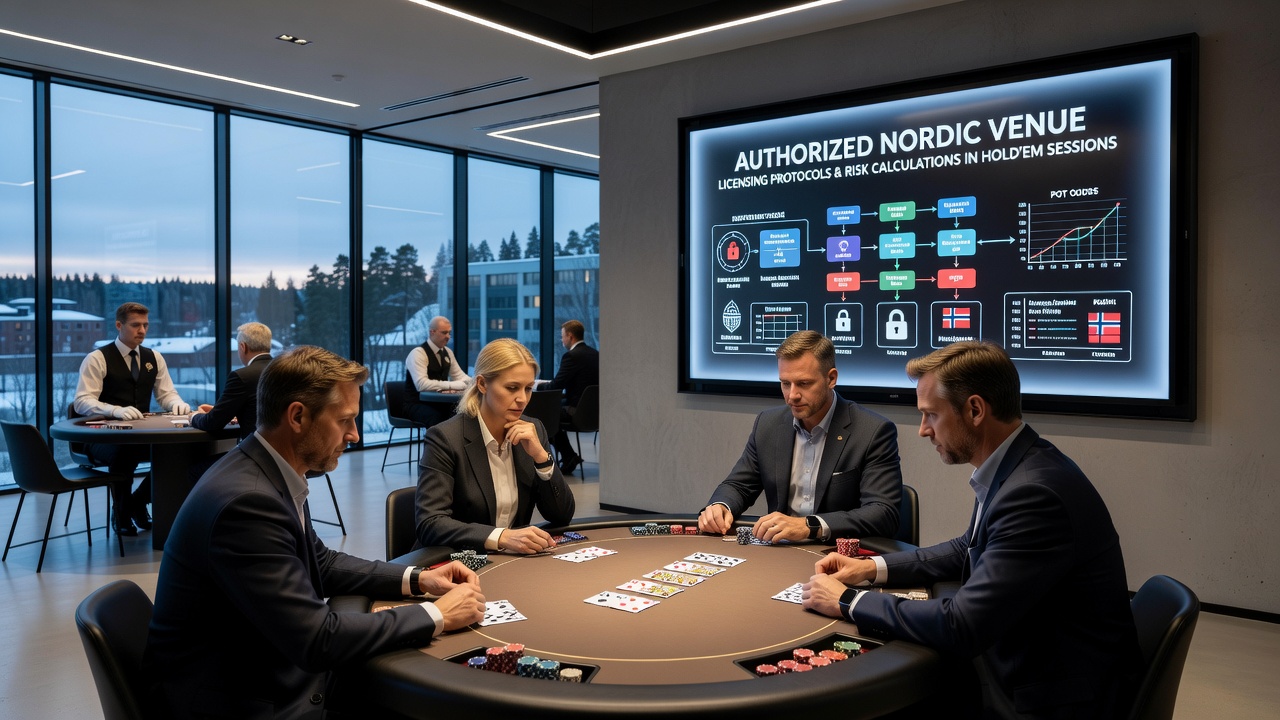
Those who study player behavior report that the segmentation effect is most pronounced among mid-stakes regulars who previously moved between multiple tables without external constraints. Now each table carries an independent loss ceiling, which narrows the mathematical window for chasing draws once the remaining segment drops below a critical percentage of the original buy-in.
October 2026 Protocol Updates
Beginning in October 2026, several Nordic operators will activate an enhanced identity-matching layer that cross-references facial recognition with national ID databases at the start of every session, and this step adds an extra verification delay that players must now build into their arrival timing calculations. The new layer also records any previous session data from other licensed venues in the same country, creating a unified risk profile that operators use to set individualized deposit or time limits. Industry reports show that early testing of the system produced a further 7 percent reduction in average session length at pilot sites in Stockholm and Copenhagen.
Tax Reporting and Post-Session Analysis
Licensed venues automatically transmit win-loss summaries to tax authorities at the close of each month, and this automatic reporting encourages players to maintain personal spreadsheets that mirror the official data feed. Participants therefore review every hand history with an eye toward future tax liability, which shifts the effective risk calculation for thin value bets or hero calls that carry upside only after taxes are considered. Data compiled by the Finnish Institute of Gaming Studies reveals that players who factor tax exposure into their models reduce their overall aggression factor by an average of 0.12 across tracked samples.
Conclusion
Licensing protocols in authorized Nordic venues generate continuous data streams, mandatory disclosures, and segmented limits that collectively redefine the inputs players use when calculating risk during hold'em sessions. These structural requirements remain consistent across the region while evolving through scheduled updates such as the October 2026 identity-matching expansion. Observers continue to track how these mechanisms influence decision patterns without altering the underlying mathematics of the game itself.